


In 1850, French economist Frédéric Bastiat published The Law, arguing that governments and laws are established to collectively protect life, liberty and property. Yet he also warned that law itself could become an instrument for violating those principles when those controlling the state acquired the power to use it against the population. That warning provides a useful lens through which to examine a series of rapidly advancing Canadian laws and policies involving online speech, surveillance, digital identification and artificial intelligence.
Bill C-9, Bill C-22, Bill C-34 and Bill C-8 are presented as responses to problems ranging from “hate” crimes to child safety to cybersecurity, while Canada is simultaneously expanding its artificial-intelligence strategy and the computing infrastructure necessary to support it. Although ostensibly aimed at protecting Canadian citizens, these bills raise serious problems related to privacy, freedom of expression and the growing ability of governments to identify, monitor and restrict individuals in the digital world.
Bill C-9 and the Regulation of Expression
Bill C-9, the Combatting Hate Act, strengthens provisions concerning “hate” crimes and propaganda while creating new offences related to intimidating or obstructing people from accessing certain religious and cultural locations. Its stated purpose is to respond more effectively to rising incidents of “hate,” with the legislation receiving royal assent on June 18, 2026. Expanding “hate”-related offences and removing certain exemptions could seriously threaten Charter protections for expression, religion and conscience.
The concern is not whether genuinely threatening or violent conduct should be prohibited, but how precisely the boundaries of prohibited expression are defined and enforced. Broad or subjective interpretations of “hatred,” intimidation and related concepts could chill lawful religious, cultural or political expression.
Bill C-22 and Access to Digital Information
Bill C-22, the Lawful Access Act, expands law-enforcement and CSIS access to information held by electronic service providers. While presented as a modernization of investigative capabilities for serious crime and national security threats, it could substantially weaken privacy protections and facilitate broader surveillance by requiring providers to maintain systems that enable government access.
Digital metadata can reveal extensive details about an individual’s activities, relationships and communication patterns without exposing the content of their messages. The scope of information accessible, how long it is retained and who can obtain it are serious concerns. Combined with laws regulating online expression, these powers could give the state both expanded authority to determine prohibited behaviour and increasingly sophisticated tools to monitor Canadians’ digital activity.
Bill C-34 and Digital Identification
Bill C-34, the Safe Social Media Act, proposes a Digital Safety Commission to regulate social-media services, chatbots and other online platforms, said to protect children and reduce harm. Enforcing age restrictions necessarily requires platforms to verify users’ ages, potentially through government-issued identification or biometric technologies.
Further, if verification becomes necessary across numerous services, it is very plausible that centralized digital identification will be encouraged as a convenient solution. Rather than repeatedly proving their age, users could simply be encouraged or forced to authenticate themselves through a common identification system. The concern around this bill is not the restrictions on minors, but the far-reaching identification infrastructure these requirements are likely to establish.
Bill C-8 and Digital Communications
Bill C-8, the Cyber Security Act, establishes cybersecurity requirements for critical infrastructure, including digital communications, finance and energy. Claimed to be a way to strengthen Canada’s resilience against cyber threats, it imposes risk-mitigation, reporting and compliance requirements on operators. Its broad powers could readily facilitate government overreach into private networks, operations and data.
The legislation also grants authorities significant powers over digital communication services, including directing providers to suspend services under specified circumstances. In an increasingly digital society, losing access to internet and communication services could also prevent individuals from working, accessing their bank accounts, using essential services and participating in public life. This raises important questions about how broadly such powers could be interpreted and what safeguards would prevent their misuse.
AI for All and the Technological Component
One practical obstacle to surveillance on such a scale is the enormous quantity of information generated by modern digital life. Social networks, communications platforms, devices and cameras produce more data than human investigators could realistically examine. Artificial intelligence removes much of that limitation by processing, connecting and analyzing enormous datasets automatically.
Canada’s AI for All strategy promotes centralized AI governance, sovereign computing infrastructure and international partnerships, creating a dangerous potential for mass surveillance, automated content moderation and expanding government control over digital systems. Combined with increasingly sophisticated data collection and identification systems, AI could enable authorities to monitor and analyze Canadians’ activities on an unprecedented scale. Expanding data centres would provide the computing power necessary to operate these technologies and is likely one of the real reasons they are being so aggressively developed.
How the Pieces Fit Together
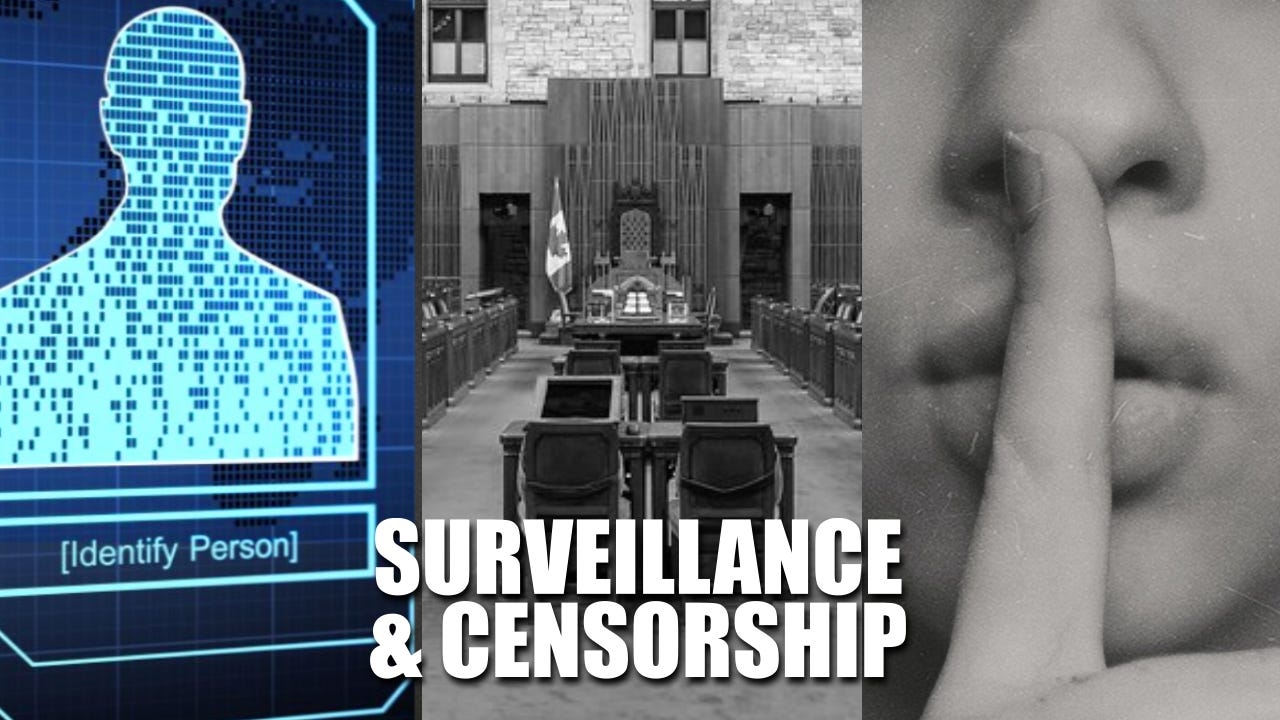
Individually, these bills are targeted at different issues, but their powers complement one another. Bill C-9 expands rules governing prohibited expression; Bill C-22 expands access to digital information; Bill C-34 could establish widespread online identification; and Bill C-8 grants powerful authority over digital communications infrastructure. Together with AI technology, they create the imminent possibility of a system capable of identifying individuals, monitoring their online activity, enforcing speech restrictions and potentially cutting off their communications access. We must continue to resist these moves to curtail freedoms and expand state control.