


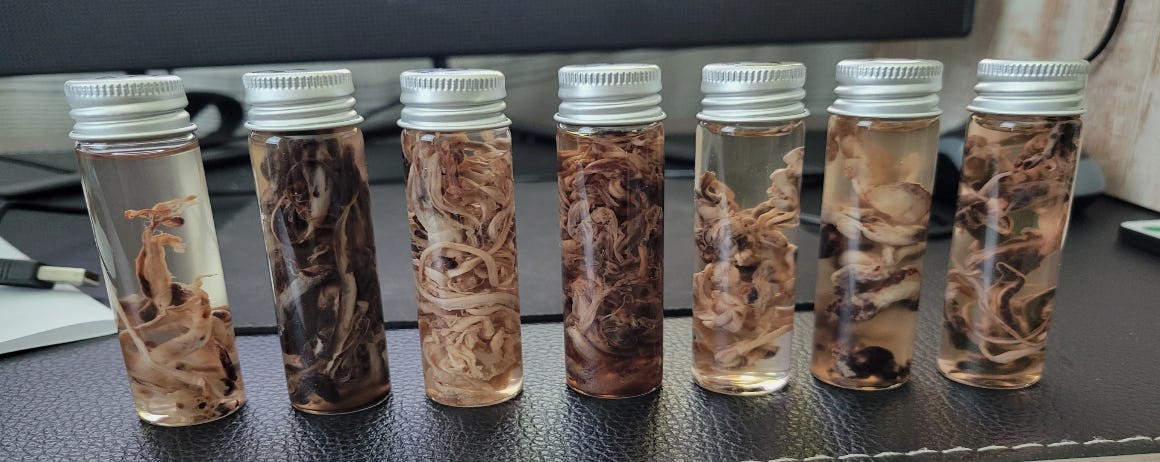
Over the past several months, we have published multiple articles and videos examining one of the most unusual pathological findings to emerge since the rollout of the COVID injections in 2021: the anomalous intravascular casts commonly known as “calamari clots.”
The first trilogy follows the scientific research itself, beginning with simple observations and progressing through increasingly sophisticated laboratory analysis. The second series features an in-depth interview with lead researcher Dr. Bruce Rapley, who explains not only the science behind these findings, but the broader biological implications, the obstacles encountered during the research, and why independent investigation remains essential.
Each installment builds on the previous one, taking you from the initial discovery through morphology, chemistry, proteomics, biological mechanisms, and finally the wider questions these findings raise for medicine and public health.
Overview: Research Trilogy
The following presentations I gave explore the scientific investigation itself. Together, the three research papers published by Dr. Bruce Rapley and Matthew Shelton examine different aspects of these unusual structures, with each study building on the findings of the previous one.
Part 1: Morphological / Histological Analysis
The investigation began with a simple question: are these white, rubbery vascular structures simply unusual blood clots, or something entirely different?
The researchers compared their appearance and microscopic structure with both classical antemortem thrombi and postmortem clots. They identified Lines of Zahn, showing that at least part of these structures formed while blood was actively circulating rather than after death. At the same time, the specimens contained remarkably few blood cells compared with conventional thrombi. Together, these consistent findings suggested that the anomalous intravascular casts may represent a novel phenomenon.

Part 2: Understanding the Chemistry
Having established that these structures appeared to be unique, the next step was to examine their chemistry.
Using elemental analysis, the researchers found that the casts were dramatically depleted in sulfur and highly enriched in phosphorus compared with conventional fibrin clots. These consistent chemical signatures suggested the presence of an additional non-protein component and could not be explained by normal clotting alone, setting the stage for molecular investigation in the final paper.

Part 3: Examining the Protein Signature
The final research paper examined the molecular composition of the casts to better understand why they behave so differently from conventional blood clots.
Proteomic analysis identified 541 human proteins, nine of which dominated the casts. The researchers found a highly abnormal fibrin composition, together with marked deficiencies of plasminogen and tissue plasminogen activator (tPA)—proteins essential for normal clot breakdown. These findings may help explain the casts’ unusual durability, continued growth, and resistance to conventional fibrinolytic therapies.

Overview: Dr. Bruce Rapley Interview
Having explored the research papers themselves, the following interview series provides additional context from lead researcher Dr. Bruce Rapley. He explains how the investigation unfolded, the biological mechanisms suggested by the findings, the challenges the team encountered, and the broader implications of their work.
Part 1: Dealing With Institutional Suppression
In the first part of the interview, Dr. Bruce Rapley provides the broader context for the investigation by explaining the difficult political landscape the research team had to navigate.
He explains how reports from embalmers and surgeons prompted the investigation, how the lack of institutional attention forced the team to pursue the research independently, and why political pressure and widespread reluctance among laboratories made obtaining scientific analyses of the clots extraordinarily difficult.

Part 2: The Mechanisms and Dangers
The second section of the interview turns to the biology behind these unusual structures.
Dr. Bruce Rapley explains how normal blood clotting differs from the formation of the anomalous intravascular casts, outlining a proposed mechanism by which microscopic injury to the blood vessel lining may trigger uncontrolled fibrin growth. He also discusses why these structures appear capable of persisting and expanding within blood vessels, offering a possible explanation for their resistance to the body’s normal clot-removal processes.

Part 3: Concerning Proteomic Findings
The third part of the interview examines the protein composition of the clots and what this likely reveals about the underlying disease process.
Dr. Bruce Rapley describes how abnormalities in fibrin, hemoglobin, and several immune-related proteins point to extensive cellular damage, inflammation, and immune activation. He also discusses how deficiencies in the normal clot-dissolving system may help explain why these casts continue to persist and grow rather than being broken down by the body.

Part 4: Novel Clots and Other Post-COVID-Injection Danger Signals
The final section of the interview broadens the discussion beyond the anomalous intravascular casts to consider their wider implications for human health and future research.
Dr. Bruce Rapley discusses how the findings fit within a broader systems-based view of disease, explores potential consequences for multiple organ systems, and calls for independent scientists to replicate the research using transparent methods. He concludes by emphasizing that only a restoration of honest and open scientific inquiry can determine the full significance of these findings.

What We Know So Far
Across these seven presentations and what we know about the injections more broadly, a concerning picture is emerging. The research documents a previously unrecognized type of intravascular cast, demonstrates that it differs from conventional blood clots in both its microscopic appearance and chemical composition, and identifies distinctive protein signatures that may explain its formation, persistence, and resistance to normal clot breakdown.
While many questions remain unanswered, knowing how these structures form and behave provides a foundation for developing diagnostic tools, investigating potential therapeutic approaches, and guiding future research. Dr. Bruce Rapley's interview series complements the published papers by explaining how the investigation unfolded, the challenges the team faced, and why independent scientific inquiry remains essential to advancing our understanding of these findings.
Are these clots being discovered recently ?
Undertakers began encountering them during the enbalming process when people started "dying suddenly".